The Transformation Economy and Accounting:
What Harvard Just Named Is What the Best Accounting Firms Already Do
Joseph Pine wrote the book that changed how business thinks about value.
His 1999 book The Experience Economy argued that competing on goods and services was no longer enough. Businesses had to stage memorable experiences. It reshaped industries from hospitality to healthcare.
Now he has written the sequel. The Transformation Economy (Harvard Business Review Press, 2026) argues that even experiences are no longer the top of the value chain.
The highest economic value, Pine says, comes from guiding customers to achieve their aspirations, from helping them become who they want to become.
If you run an accounting firm, that sentence should stop you in your tracks.
Because what Pine has just given a name to, and what Harvard has just published, is the exact shift that a small number of forward-thinking firms have already made. And it is the shift that most firms are still structured to prevent.
Pine’s Progression of Economic Value
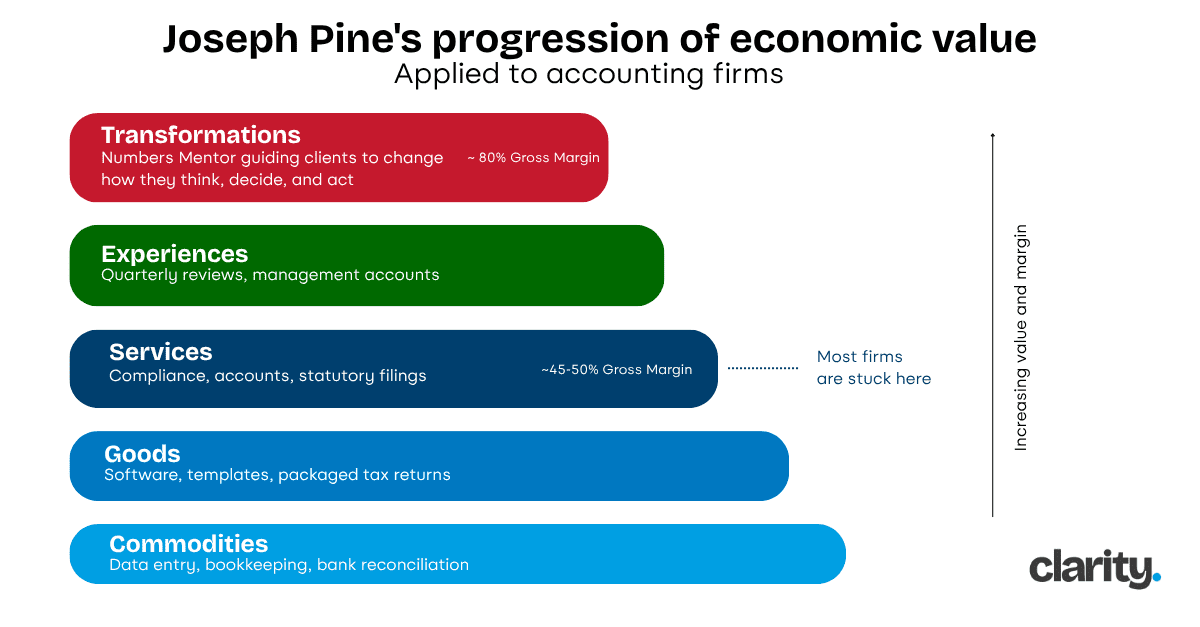
Pine maps economic evolution as a progression. Each step up creates more value, commands higher margins, and builds deeper loyalty. The five stages, in ascending order, are: commodities, goods, services, experiences, and transformations.
At the commodity level, you extract raw materials and compete on price. At the goods level, you manufacture products and compete on features. At the services level, you deliver activities on behalf of a customer and compete on quality. At the experience level, you stage memorable events and compete on sensation. And at the transformation level, you guide customers to achieve their aspirations and compete on demonstrated outcomes.
The critical insight is this: at each stage, the thing you sell changes. But at the transformation level, what changes is the customer themselves. Pine puts it plainly. With transformations, inputs do not matter. Only the outcomes that customers achieve.
The Transformation Economy, as defined by B. Joseph Pine II, is the economic stage beyond the Experience Economy where businesses create the highest value by guiding customers to achieve their aspirations and become who they want to become. The measure of success is not the input delivered but the outcome the customer achieves.
Where Most Accounting Firms Sit on This Progression
Here is the uncomfortable truth. Most accounting firms are stuck at the services level. They deliver compliance work (tax returns, accounts, statutory filings) and compete on turnaround time, accuracy, and increasingly, price. That is a services business. It is honourable work. But it is the middle of Pine’s progression, and it is being commoditised faster than most partners want to admit.
Some firms have tried to move up. They bolt on advisory, usually in the form of quarterly meetings where a partner presents a set of management accounts and talks through the numbers. This feels like progress, but in Pine’s framework, it barely qualifies as an experience. The client sits, listens, nods, and goes back to running their business the same way they did before.
Nothing changes. The client does not transform. And the firm cannot charge transformation-level fees for a service-level interaction.
The Broken Advisory Model Keeps Firms at the Wrong Level
This is where Pine’s framework intersects with a problem I have spent the last decade diagnosing. The traditional advisory model, as most accounting firms practise it, actually reduces firm profitability by 30%. Compliance-only firms average £118k profit. Add bespoke advisory on top (the way most firms do it) and profit drops to £83k. That is not a rounding error. That is a systemic failure.
Why does this happen? Because the traditional model treats advisory as an add-on to compliance rather than a standalone value proposition. The partner does the advisory work themselves (usually on instinct rather than a repeatable methodology), undercharges because they cannot articulate the value, and absorbs the time cost without recovering it. The client gets a nice conversation. The firm gets a margin problem.
In Pine’s terms, these firms are trying to charge transformation-level prices for what is, structurally, still a service. The model does not support the outcome. And clients can feel it.
Key data point: Compliance-only firms average £118k profit. Adding traditional advisory drops profit to £83k (a 30% reduction). Switching to a structured NextGen Advisory model produces £389k (a 3x increase).
Source: Clarity HQ analysis across 17+ countries.
What a Transformation-Level Accounting Firm Actually Looks Like
A firm operating at Pine’s transformation level does not just report numbers. It uses numbers as the starting point for a structured process that changes how a business owner thinks, decides, and acts. The outcome is not a set of accounts. The outcome is a business owner who understands their 7 Key Numbers, knows which lever to pull next, and has the confidence to do it.
That is transformation in the Pine sense. The customer is different on the other side. Not just informed. Changed.
Pine identifies four categories of aspiration that transformations serve: well-being, prosperity, knowledge, and purpose. Look at what the best advisory-led accounting firms deliver and you will find all four. Prosperity (the obvious one) through structured financial improvement. Knowledge through ongoing commercial education. Purpose through helping business owners reconnect with why they started. And well-being because a business owner who finally understands their cash position sleeps better at night.
This is not soft language. It is the commercial rationale for why transformation-level advisory commands gross profit margins of around 80%, compared to 45-50% for compliance work.
The Numbers Mentor as Transformation Guide
Pine introduces the concept of the “guider”: the business or individual whose role is to guide the customer through their transformation journey. The guider does not just provide inputs. The guider diagnoses, challenges, supports, and holds the customer accountable for their own progress.
At Clarity HQ, we call this the Numbers Mentor.
A Numbers Mentor is an accountant who has made the shift from reporting what happened to changing what happens next. They diagnose before they prescribe. They challenge as well as support. And they use a structured methodology (not instinct, not a generic slide deck) to guide their clients through measurable commercial improvement.
Pine’s guider concept and the Numbers Mentor identity are not just similar. They describe the same commercial role. The difference is that Pine theorised it. We built the system that makes it operational.
The Support and Challenge Model
Pine’s transformation framework describes a journey where the guide must balance encouragement with honest confrontation. This maps directly to a principle we have taught for years: the best advisory relationships operate on two axes simultaneously. Support (through numbers, data, and reassurance) and challenge (on decisions, accountability, and follow-through).
Most accountants only operate on the support axis. They present the numbers, answer questions, and try to be helpful. The traditional model never gave them the structure, the language, or frankly the permission to challenge. But an accountant who only supports is always vulnerable to being replaced. By a cheaper firm, by software, or increasingly by AI.
The mentor who supports and challenges in equal measure becomes the most valuable person in the client’s business life. Pine would call that a transformation guide. We call it a Numbers Mentor. The economics are the same either way.
Why AI Makes This More Urgent, Not Less
There is a fourth force accelerating this shift that Pine does not address directly but that is already reshaping accounting. Roughly half of small business owners are now using generic AI tools (ChatGPT, Gemini, Copilot) to ask questions about cash flow, margins, hiring, and investment. They are getting answers. Fast ones. Confident ones.
And dangerously wrong ones.
Stanford research published in late 2025 found that leading AI models affirm users’ decisions 50% more than a human advisor would, even when those decisions involve poor judgement (Cheng et al., arXiv:2510.01395). The AI tells them what they want to hear. It validates bad plans. It agrees with flawed assumptions. And it does this confidently, because that is what it is optimised to do.
In Pine’s framework, generic AI is the opposite of a transformation guide. It is a sycophant. It makes the customer feel good without making them better. And it does it at zero cost, which means the accountant who is also just presenting numbers and being supportive is now competing with something free.
The only defensible position is the one Pine describes at the top of his progression. Guide the transformation. Challenge as well as support. Use methodology, not instinct. And use AI that is built to do the same.
Stanford research finding: AI models affirm users’ decisions 50% more than human advisors, even when those decisions involve poor judgement. (Cheng et al., arXiv:2510.01395, Oct 2025.)
For accounting firms, this means generic AI is actively undermining the advisory relationship unless the firm provides a structured alternative.
How Clarity HQ’s Methodology Maps to the Transformation Economy
Pine describes a Transformation Journey modelled on the hero’s journey. The customer starts in their ordinary world, encounters a catalyst for change, commits to the journey, faces challenges, achieves transformation, and returns to a higher plane of operation. He describes this as a helix, spiralling upward with each cycle.
The Clarity HQ NextGen Advisory methodology follows the same arc, but makes it operational for accounting firms. The CLEAR Advisory Map provides the diagnostic framework. The 7 Key Numbers (Revenue Growth, Gross Profit %, Operating Profit %, Core Cash Target, Cash Days, Business Return, and Revenue Per Employee) give the journey measurable waypoints. The 5 Levers of Success turn abstract improvement into specific actions.
And the whole thing is supported by technology designed to reinforce (not replace) the mentor relationship. Numina helps the accountant prepare for advisory conversations using methodology rather than instinct. Hartley (askhartley.ai) gives clients an AI assistant that knows their actual numbers and challenges bad assumptions rather than agreeing with them.
This is the practical infrastructure of Pine’s Transformation Economy applied to accounting. The theory says businesses should guide customer transformation. The system shows accounting firms exactly how to do it.
What This Means for Your Firm
Pine’s book gives academic and commercial credibility to something a growing number of accounting firms have already discovered: the money, the loyalty, and the professional satisfaction all live at the transformation level.
If your firm is still structured to deliver compliance with advisory bolted on, you are operating at the services level of Pine’s progression. You are competing on hours, on turnaround, and increasingly on price. And you are exposed to AI-driven commoditisation from below and client expectations from above.
The alternative is to restructure around transformation. Diagnose before you prescribe. Use methodology, not instinct. Charge for outcomes, not inputs. Support and challenge in equal measure. Become the most valuable person in your client’s business life.
Pine calls it the Transformation Economy. We call it NextGen Advisory. The destination is the same. The question is whether your firm has the structure to get there.