What Is Business Advisory for Accounting Firms?
If you run an accounting firm in 2026, you’ve heard the phrase “business advisory” hundreds of times. At conferences. In vendor emails. From industry bodies insisting it’s the future. But despite all the noise, most firms are still stuck in the same place: compliance work dominates, advisory feels like something only partners can deliver, and clients don’t seem willing to pay for vague “strategic advice.”
This guide cuts through the jargon. We’ll explain what business advisory actually means in practice, why most firms struggle to make it work, and how the firms that have cracked it are generating significant recurring revenue from advisory – often within their first 90 days.
Business Advisory for Accounting Firms
Business advisory, in the context of accounting, is the practice of using financial data and business insight to help clients make better decisions. It goes beyond producing reports. It means helping a business owner understand where their business is today, where it could realistically get to, and what specific actions will close that gap.
That sounds straightforward. So why do so many firms struggle with it?
The problem is that “advisory” has been treated as a single, monolithic service – something that requires deep strategic expertise, hours of preparation, and a partner in the room. In reality, advisory exists on a spectrum. At one end, it’s simply showing a client where they stand relative to similar businesses. At the other, it’s full-scale consulting on growth strategy, funding, and exit planning.
Understanding this spectrum is essential. Not every client needs (or wants) the consulting end. But almost every client benefits from the awareness and accountability end – and that’s work any trained team member can deliver.
The 5 Levels of Business Advisory
One of the most useful frameworks for thinking about advisory is the idea that it operates across five distinct levels. Each level builds on the one before, and different team members in your firm can deliver at different levels:
Level 1: Awareness. Show the client where their business is right now. This means translating their financial data into a simple, visual story they can actually understand. Most business owners don’t read management accounts. They need someone to say: “Here are the 7 numbers that matter. Here’s where you sit.” This can be delivered by any team member with access to the data and a structured framework.
Level 2: Benchmarking. How does the client compare to similar businesses in their sector and location? This adds context to the raw numbers. A 15% net margin might sound fine until the client sees that the sector average is 22%. Benchmarking creates the motivation for change without the accountant having to “sell” anything.
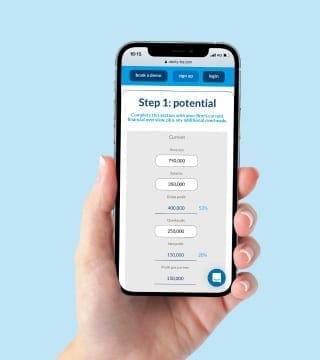
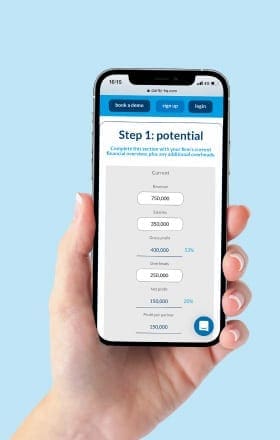
Level 3: Potential. What could this business achieve if it improved in the right areas? This is where sensitivity analysis comes in – showing the client what happens to their profit and cash position if they move the key levers (price, volume, cost of goods, overheads, debtor days). The visual impact of this is what makes clients say yes to advisory engagements.
Level 4: Planning. Co-create an action plan with the client. This includes financial plans, cashflow forecasts, funding plans, and specific tasks with deadlines. The plan should be a living document, not a PDF that sits in a drawer.
Level 5: Accountability. The ongoing review cycle. Meet regularly (monthly or quarterly), compare actual results to the plan, discuss what worked and what didn’t, set new actions, and hold the client accountable. This is where the recurring revenue lives – and it’s also where the real value is delivered.
Why Most Firms Get Stuck
The accounting profession has been talking about advisory for over a decade. So why are most firms still delivering it only to their top 10–20% of clients through their most senior people?
There are four main barriers:
The partner bottleneck. When advisory is unstructured, only the most experienced people can deliver it. Partners become the constraint, and advisory never scales beyond a handful of clients.
No repeatable process. Without a defined methodology, every advisory engagement is bespoke. That means inconsistent quality, unpredictable time commitments, and difficulty training new team members.
Clients don’t understand what they’re buying. Accountants try to sell “management accounts” or “cashflow forecasting” or “budgeting.” Business owners don’t care about any of those things. They care about making more money, having more time, and building a business they could eventually sell. The advisory conversation needs to start with outcomes, not deliverables.
Pricing uncertainty. How do you price something you can’t clearly define? Firms either undercharge (because they’re not confident in the value) or overcharge relative to what’s delivered (because they’re pricing for partner time). Neither approach is sustainable.
The Shift: From Bespoke to Repeatable
The firms that have successfully scaled advisory have all made the same fundamental shift: they’ve moved from bespoke, partner-led advisory to repeatable, system-driven advisory that any trained team member can deliver.
What does “repeatable” mean in practice? It means having a defined process for the first client meeting. A structured way to present the numbers. A benchmarking system that works the same way for every client. A sensitivity analysis tool that creates visual, compelling output. Meeting templates and agendas. Follow-up email sequences. Pricing frameworks based on the level of advisory being delivered.
When the process is systemised, three things happen. First, junior team members can deliver advisory confidently – they’re following a proven framework, not improvising. Second, quality becomes consistent – every client gets the same structured experience. Third, it scales – you’re no longer limited by how many hours the partners have in their diary.
Data from firms using structured advisory approaches shows that the time investment drops dramatically compared to bespoke delivery. Some firms report a 67% reduction in advisory delivery time, while maintaining or improving client outcomes.
How to Price Advisory Services
Pricing is where many firms freeze. Here’s a practical framework.
Start by mapping your advisory offering to the five levels above. Not every client needs Level 5. Some clients genuinely only need awareness and benchmarking (Levels 1–2). Others need the full planning and accountability cycle (Levels 1–5).
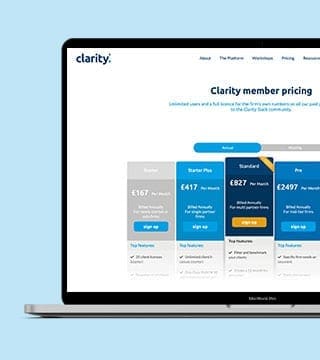
Create 2–3 packages at different price points. A common structure: a starter package at £150–300/month covering diagnostics and benchmarking, a growth package at £300–600/month adding planning and quarterly reviews, and a premium package at £600+/month for monthly consulting-level support.
The key insight: don’t start by trying to sell the premium package. Lead with the diagnostic meeting. When clients see their numbers visualised, benchmarked, and stress-tested, they naturally see the value in ongoing support. Firms using this approach consistently report conversion rates above 60% from diagnostic meetings to ongoing advisory engagements.
And check out our guide here How To Price Advisory Services.
Getting Started: A 90-Day Roadmap
Weeks 1–2: Choose your framework and tools. You need a structured methodology, a way to quickly pull financial data, and a benchmarking capability. Decide whether you’re building this yourself or using an existing platform.
Weeks 3–4: Train your first delivery team. Choose 2–3 team members who are good with clients. Walk them through the process end-to-end. Run practice sessions with dummy data.
Weeks 5–8: Run your first 10–20 diagnostic meetings. Start with existing clients who you know are open to deeper engagement. Use these meetings to refine your delivery, test your pricing, and build confidence.
Weeks 9–12: Review and systematise. What worked? What needs refining? By this point, you should have a repeatable process, clear pricing, and a growing pipeline.
Firms that follow this approach typically generate £30k+ in gross recurring fees within the first 90 days. That’s the consistent experience across hundreds of firms in 30+ countries.
The Role of Technology
Technology doesn’t replace the advisory conversation. But it makes it dramatically more efficient and impactful. The best advisory technology pulls financial data automatically from cloud accounting systems (Xero, QuickBooks, Sage), benchmarks clients against real data from similar businesses, creates visual output that clients understand and respond to, and provides a meeting structure that makes advisory repeatable.
Some firms build their own process using spreadsheets. This works at a small scale but breaks down as you try to deliver to more clients. Dedicated business advisory platforms exist specifically to solve this scaling problem.
The Business Case: Why Advisory Matters Now
Compliance revenue is under sustained pressure. Automation and AI are reducing the time required for traditional accounting. Clients are demanding more. Industry data consistently shows that firms combining compliance and advisory are significantly more profitable than compliance-only firms – often three times more profitable.
But beyond profitability, small businesses that receive advisory support from their accountant are more likely to survive and grow. In the UK, only 4 in 10 businesses survive five years. Accountants are uniquely positioned to improve those odds – they already have the data, the relationship, and the trust.
Summary
Business advisory for accounting firms isn’t about becoming a management consultant. It’s about using the data you already have, the relationships you’ve already built, and a structured process to help clients make better decisions. The firms getting it right have moved from bespoke to repeatable, from partner-led to team-delivered, and from selling deliverables to demonstrating outcomes.
About Clarity HQ: Clarity HQ is the business advisory platform for accounting firms. It combines software, education, and consulting to help your firm market, sell, price, and deliver advisory services at scale. Book a call at clarity-hq.com to learn more. Hartley is our new client-facing AI Advisory Assistant.